
Why Do Babies Hit Themselves In The Head: Causes And Tips

Introduction
If your baby hits their head with a hand, bumps their head on a safe surface, or bangs their head during crying, the behavior can look scary. In the United States, this is often a short-term way for a baby to show stress, manage strong feelings, or soothe themselves. It does not always mean that something is seriously wrong.
Still, head hitting deserves close attention. The meaning depends on your baby’s age, the force used, how often it happens, and whether other symptoms appear. This guide explains common causes, what parents can do at home, and when to call a pediatrician or seek emergency care.

Why do babies hit themselves in the head?
Babies may hit themselves in the head because they are tired, upset, frustrated, overstimulated, in pain, or trying to calm themselves. Young babies have limited control over their arms and no words to explain what they need. A hit or head bang may be their way of releasing stress.
Common causes include:
- Fatigue: Babies may hit their heads when they need sleep.
- Frustration: Older babies may react this way when they cannot reach a toy, move freely, or express a need.
- Overstimulation: Bright lights, loud sounds, crowds, or too much activity can overwhelm a baby.
- Self-soothing: Some babies use repeated movements to relax before sleep.
- Teething discomfort: Sore gums can make a baby rub, slap, or hit the face and head.
- Physical pain: An ear infection, headache, injury, reflux, constipation, or other discomfort may change behavior.
- Attention or communication: A baby may repeat the action after adults react strongly.
- Habit: Repeated movements can become part of a bedtime or calming routine.
Most occasional head hitting is not dangerous when the baby is alert, developing as expected, and not using enough force to cause injury. The action itself matters less than the full pattern around it.
According to the American Academy of Pediatrics, repetitive movements such as head banging may occur as babies fall asleep or wake during the night. These movements often stop as children grow. However, a pediatrician should assess behavior that causes injury, happens often during the day, or appears with developmental or medical concerns.

What does head hitting mean at different ages?
Age can help explain why a baby hits their head, but it does not provide a diagnosis by itself.
Newborns to about 4 months
A young baby may swing their arms or hit their face by accident. Newborns have limited control of their movements. They may also move more when hungry, tired, cold, or uncomfortable.
At this age, look for basic needs first:
- Hunger
- A wet or dirty diaper
- Gas
- Too much heat or cold
- Lack of sleep
- Loud noise or bright light
- Tight clothing
- Signs of illness
A newborn who repeatedly hits the same spot, cries in pain, feeds poorly, or seems unusually sleepy needs medical advice.
About 4 to 12 months
Babies in this age range become more aware of cause and effect. They may hit their head during a tantrum, when a toy is taken away, or when they cannot communicate what they want.
Some babies also bang their heads against a crib mattress, wall, or floor before sleep. Gentle, rhythmic movement can be a form of self-soothing. It is less concerning when it occurs only near sleep and does not cause injury.
Around 12 months and older
Toddlers may hit their heads because they have strong feelings but limited speech. The behavior may occur during anger, limits, transitions, or frustration.
At this stage, parents can begin teaching simple words and gestures such as “help,” “more,” “all done,” and “hurt.” The goal is not to punish the movement. The goal is to help the child use a safer way to communicate.

Is it normal for a baby to bang their head before sleep?
Head banging before sleep can be a normal self-soothing behavior. Some babies rock, roll, hum, rub their heads, or lightly tap a surface as they become drowsy. This usually causes no harm when the sleep area is safe and the movement is mild.
A safe sleep setup still matters. The American Academy of Pediatrics recommends that babies sleep:
- On their backs for every sleep
- On a firm, flat sleep surface
- In a crib, bassinet, or portable play yard
- Without pillows, blankets, bumpers, toys, or other soft objects
- In the same room as a caregiver, but not in the same bed
Do not add padding, pillows, or crib liners to stop head banging. These items can increase the risk of suffocation or entrapment. Do not use a weighted sleep product unless your child’s doctor gives specific guidance.
Watch the pattern rather than trying to stop every movement. Contact your child’s pediatrician if the behavior is forceful, leaves marks, interrupts sleep, happens while the baby is fully awake, or continues with other concerning signs.
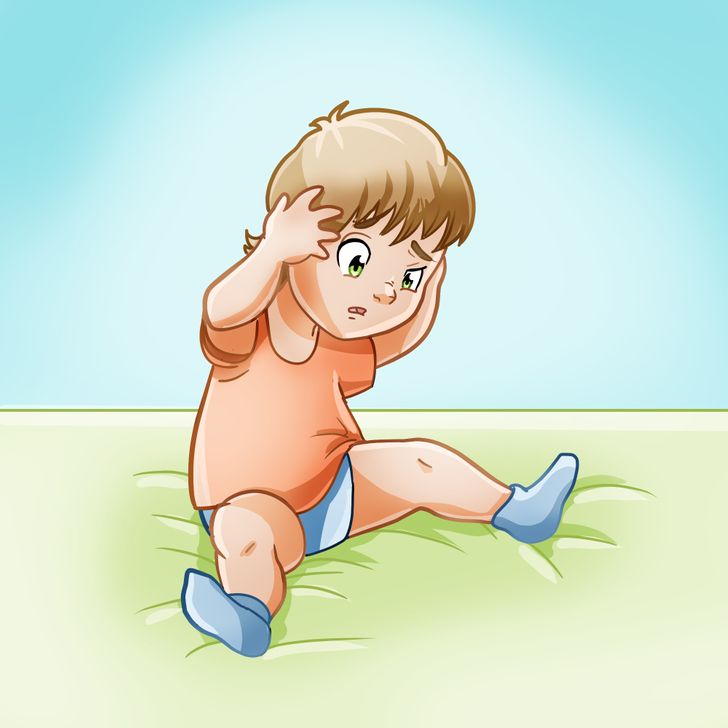
Could teething or an ear infection cause head hitting?
Yes. Pain or pressure can make a baby touch, rub, pull, or hit the side of the head. Teething may cause sore gums and irritability. An ear infection may cause ear pulling, crying, poor sleep, fever, or more distress while feeding.
Ear pulling alone does not prove an ear infection. Babies also touch their ears when they are tired or curious. A clinician must examine the eardrum to diagnose an ear infection.
Call your pediatrician if head hitting occurs with:
- Fever
- Ear drainage
- Repeated ear pulling with crying
- Poor feeding
- Vomiting
- Trouble sleeping due to pain
- A sudden change in behavior
- Fewer wet diapers
- A baby who seems hard to comfort
Do not place cotton swabs, oil, or non-prescribed drops into a baby’s ear. Ask a pediatrician before giving medicine for pain or fever. The correct product and dose depend on the baby’s age and weight.

How can parents respond when a baby hits their head?
Respond calmly and protect the baby from injury. A large, frightened reaction can increase distress or make the behavior more rewarding because it brings quick attention.
Use this sequence:
- Check for immediate danger. Move hard or sharp objects away. If needed, gently place your hand between the baby’s head and the surface.
- Stay calm. Use a soft voice and slow movements.
- Check basic needs. Look for hunger, tiredness, a wet diaper, heat, cold, or overstimulation.
- Offer comfort. Hold the baby if they want contact, reduce noise, dim the lights, or move to a quiet room.
- Redirect safely. Offer a teether, soft song, cuddle, or simple toy when the baby is calm.
- Use simple words. Say, “You are upset. I will help you,” or “Gentle hands.”
- Track the pattern. Write down when it happens, what came before it, how hard the baby hit, and what helped.
Do not shake, yell at, slap, or restrain a baby. Never shake a baby, even for a few seconds. If you feel overwhelmed, place the baby on their back in an empty crib and step away for a short time while you calm down. Ask another trusted adult for help.

How can you tell whether the behavior is mild or concerning?
A simple pattern check can help. It is not a medical diagnosis, but it can guide your next step.
| Pattern | What it may suggest | What to do |
|---|---|---|
| Light taps during play or crying | Frustration, communication, or normal movement | Stay close, block injury, and look for the trigger |
| Gentle rhythmic movement before sleep | Self-soothing | Follow safe sleep rules and monitor |
| Head hitting during teething signs | Mouth pain or discomfort | Offer safe teething support and call the pediatrician if severe |
| Sudden, forceful head hitting | Pain, illness, stress, or injury | Contact the pediatrician promptly |
| Repeated daytime behavior that causes marks | A need for medical or developmental assessment | Schedule an appointment |
| Head hitting with loss of skills or unusual movements | Possible developmental or neurologic concern | Call the pediatrician soon |
The most useful clues are frequency, force, timing, triggers, and recovery. A baby who calms quickly and returns to normal behavior is different from a baby who remains unusually sleepy, weak, confused, or difficult to comfort.

When should you call a pediatrician?
Call your baby’s pediatrician if head hitting is new, frequent, forceful, or linked with pain. You should also make an appointment if you are worried, even when you cannot identify a clear cause.
Discuss the behavior if your baby:
- Hits the head hard enough to leave swelling, bruising, bleeding, or repeated red marks
- Does it many times each day
- Does it during sleep and wakes with injuries
- Seems to favor one side of the head
- Has repeated vomiting
- Has a fever or signs of infection
- Has trouble feeding or sleeping
- Seems unusually irritable or unusually quiet
- Loses a skill they previously had
- Does not respond to sounds, faces, or touch as expected
- Has stiffening, jerking, staring spells, or unusual pauses
- Has poor muscle control or seems weaker than usual
Take a short video if the movement is safe to record. Note the baby’s state before, during, and after the event. This can help the clinician distinguish a habit, a pain response, a sleep movement, or another condition.
The Centers for Disease Control and Prevention recommends tracking developmental milestones and discussing concerns early. Parents do not need to wait for a routine visit if a baby loses skills or seems unwell.

When is head hitting an emergency?
Call 911 in the United States after a serious head injury or if your baby has emergency symptoms. Seek immediate care for:
- Loss of consciousness
- Trouble breathing
- A seizure
- Severe bleeding
- A deep cut
- Repeated vomiting after a head injury
- Increasing sleepiness or inability to wake normally
- Confusion or behavior that is very different from usual
- A soft spot that appears swollen after an injury
- Weakness, trouble moving, or unequal pupils
- Clear fluid or blood from the nose or ears
- A fall from a significant height or impact with a hard object
After a minor bump, comfort the baby and observe closely. Do not assume that every bump is harmless. When in doubt, call the child’s doctor or seek urgent care.
For immediate emergencies, call 911. For non-emergency questions in the United States, contact the child’s pediatrician, an urgent care center, or your local nurse advice line.

Does head hitting mean autism?
Head hitting alone does not mean that a baby has autism. Many babies and toddlers hit, rock, flap, or repeat movements at times. These actions can happen during tiredness, frustration, excitement, or distress.
Autism involves a broader pattern of differences in social communication and restricted or repetitive behaviors. One behavior cannot confirm or rule it out. A clinician considers development across time, including responses to people, gestures, sounds, play, language, and changes in routine.
Talk with your pediatrician if head hitting occurs with delayed communication, loss of skills, limited response to name, little eye contact, unusual repetitive play, or other developmental concerns. Early evaluation can help identify support needs. It does not mean that a diagnosis is certain.
Parents can also contact their state’s early intervention program. In the United States, families can find local resources through the CDC’s “Learn the Signs. Act Early.” program and the Early Childhood Technical Assistance Center.

Common mistakes to avoid
Parents often try to stop head hitting quickly, but some responses can make the situation less safe.
Avoid these mistakes:
- Reacting with panic: A strong reaction may increase fear or attention.
- Punishing the baby: Infants do not have the skills to control strong feelings in the way older children can.
- Holding the baby down by force: This can increase distress and may cause injury.
- Putting pillows or padding in the crib: Soft items can raise the risk of suffocation.
- Ignoring possible pain: A behavior change can be a sign of illness.
- Assuming it is always teething: Fever, feeding trouble, or severe pain needs medical review.
- Blaming yourself: Babies use odd movements while their nervous systems and communication skills develop.
- Waiting after a serious injury: Emergency signs require immediate care.
The safest response combines protection, calm comfort, basic-needs checks, and medical advice when the pattern changes.

Frequently asked questions
Why does my baby hit their head when crying?
Crying raises stress, and babies may move their arms or hit their heads as they try to release tension. Frustration, tiredness, hunger, pain, or overstimulation can also play a role. Calm the baby, check basic needs, and watch for symptoms of illness.
Why does my baby slap their face or head?
Young babies often have limited control of their arms. They may also slap their face when tired, excited, upset, or uncomfortable. If the movement is forceful, one-sided, or linked with pain or illness, contact the pediatrician.
Can a baby hurt their brain by lightly hitting their own head?
Light, occasional taps are unlikely to cause a serious brain injury. Risk rises with forceful impacts against hard surfaces or with falls and other accidents. Seek urgent medical care after a significant impact or if warning signs appear.
Should I stop my baby from head banging?
Protect the baby from hard or sharp surfaces, but do not use force or unsafe crib padding. If the movement is mild and occurs near sleep, observe it. Ask the pediatrician for guidance if it causes injury, happens often, or occurs with developmental or medical concerns.
What should I record for the doctor?
Record the time, setting, trigger, duration, force, body area involved, and what helps. Also note fever, feeding changes, sleep changes, vomiting, unusual movements, or lost skills. A short video may be useful when recording can be done safely.
Conclusion
Babies may hit themselves in the head because they are tired, frustrated, overstimulated, uncomfortable, or trying to self-soothe. Occasional mild movements are often part of early development. The behavior needs more attention when it is forceful, frequent, painful, linked with illness, causes injury, or appears with developmental changes.
Stay calm, keep the environment safe, follow safe sleep guidance, and look for patterns. Call your pediatrician when the behavior concerns you. Call 911 after a serious injury or when emergency symptoms occur.


